Abstract
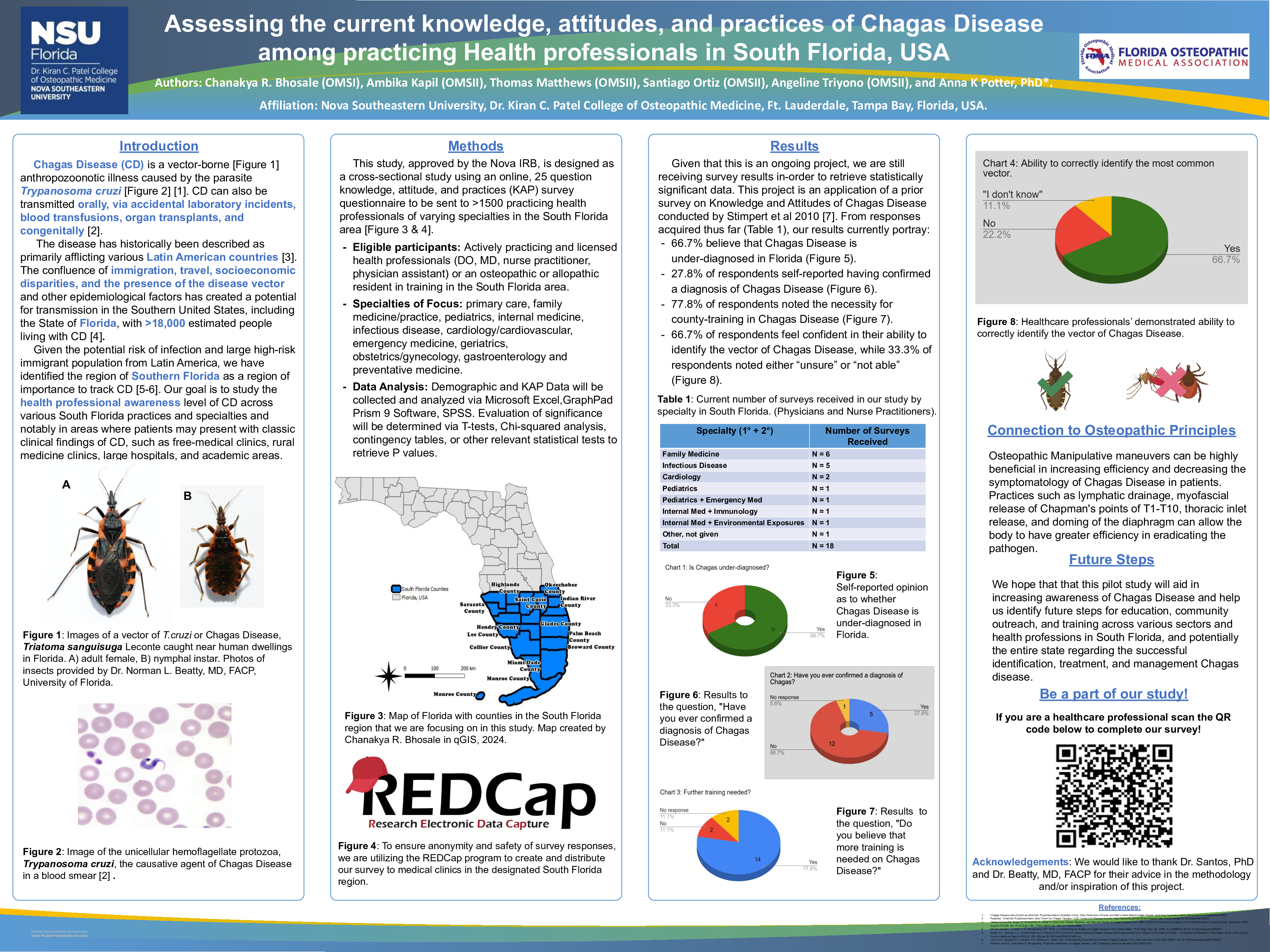
Background: Chagas Disease (CD) is a vector-borne anthropozoonotic illness caused by the parasite Trypanosoma cruzi. The disease has historically been described as primarily afflicting Latin America. However, the confluence of immigration, travel, socioeconomic disparities, and the presence of the disease vector and other epidemiological factors has created a potential for transmission in the Southern United States. Given the escalating risk of infection and large high-risk immigrant population from Latin America, we have identified the region of Southern Florida as a region of importance to track CD. We hypothesized this region as a potential large high-risk area which will become imperative for medical practitioners to possess to diagnose and manage CD. Nevertheless, prior research has highlighted a notable deficiency in knowledge and practices concerning this neglected tropical disease in the US, with no specific studies conducted among Florida medical practitioners across various specialties of interest.
Objectives: The main objective of this study is to evaluate the current knowledge, attitudes, and practices relating to CD among healthcare professionals across various specialties and demographics practicing in South Florida. Therefore, we hypothesized this region to bear the potential for a considerable burden of CD and thus warranting a comprehensive examination of the medical community's preparedness to address this emerging health concern.
Methods: This study, approved by the IRB, is designed as a cross-sectional study using an online, 22 question knowledge, attitude, and practices (KAP) survey questionnaire to be sent to >500 practicing health professionals of varying specialties in the South Florida area. Eligible participants in this study will be actively practicing and licensed health professionals (DO, MD, nurse practitioner) or an osteopathic or allopathic resident in training in the South Florida area. Demographic and KAP Data is collected and analyzed via Microsoft Excel. Statistical analyses are performed via GraphPad Prism 9 Software, SPSS, or other relevant software when needed. Analyses are compared for the distribution of responses from health professional type, specialty, training experience, and other demographics retrieved. In addition, differences in responses between respondents are evaluated using T-tests, Chi-squared analysis, contingency tables, or other relevant statistical tests to retrieve P values.
Results: Our results showcase significant differences in KAP among the varying demographics and professions in South Florida. Our results are also compared to other similar surveys conducted in other areas of the USA to show an overall disparity on CD.
Conclusion: We hope that our pilot study will aid in increasing awareness of CD and help us identify future steps for education, community outreach, and training across various sectors and health professions in South Florida, and potentially the entire state regarding the successful identification, treatment, and management CD. Given the disease process of the Chagas disease, Osteopathic Manipulative maneuvers can be highly beneficial in increasing efficiency and decreasing the symptomatology of patients. Practices such as lymphatic drainage, myofascial release of Chapman's points of T1-T10, thoracic inlet release, and doming of the diaphragm can allow the body to have greater efficiency in eradicating the pathogen.